
.svg)
PACHA (Participatory Analytics for Climate-Health Adaptation in Disadvantaged Urban Communities in Brazil)
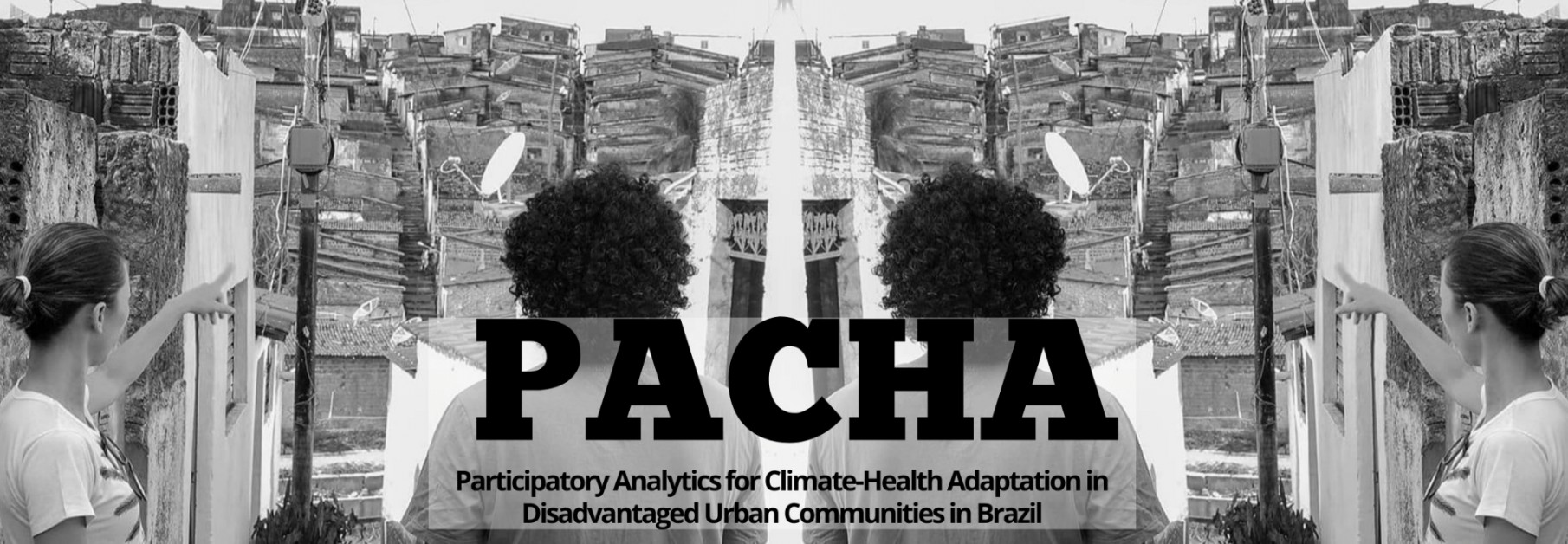
About PACHA
PACHA is a transdisciplinary international partnership working to improve climate resilience and health equity in Brazil's favela communities. Led by Professor João Porto de Albuquerque from UBDC at the University of Glasgow, PACHA consortium includes several partner institutions in Brazil: Getulio Vargas Foundation (FGV-EAESP, School of Business Administration of Sao Paulo), Fiocruz (CIDACS – Centre for Data and Knowledge Integration for Health of Owsaldo Cruz Foundation), Federal University of Rio Grande do Norte (UFRN), and the Pontifical University of Paraná (PUCPR).
The project responds to a pressing challenge: people living in favelas and urban informal communities are among the most affected by climate change but are often the least visible in the data used to guide public policy and investment in climate adaptation. Bringing together community leaders, policymakers, researchers, health experts and climate scientists, PACHA combines scientific evidence with the lived experiences of residents to better understand how climate change affects health and wellbeing. Working in the Brazilian cities of Curitiba, Natal and Niterói, the project is establishing an innovative methodology of Participatory Urban Living Labs to co-create practical, locally relevant solutions that support fairer and more effective climate adaptation.
Using a mixed-methods approach to Participatory Analytics, PACHA will combine climate and health data, intersectional multi-level analysis of impacts and vulnerabilities, and participatory action research with affected communities to translate lived experiences into citizen data. Through an innovative digital platform and participatory research methods, PACHA will help ensure that disadvantaged urban communities are recognised, heard and included in climate decision-making. The knowledge, tools and approaches developed through the project will be designed for use across Brazil and throughout Latin America, supporting more inclusive and evidence-based urban climate action.
Aims and Objectives
PACHA aims to reduce the health impacts of climate change on disadvantaged urban communities by making their experiences, vulnerabilities and priorities visible in climate adaptation planning.
The project will:
- Improve understanding of how climate change affects the health and wellbeing of favela communities.
- Identify how factors such as gender, age, race and place shape climate-related vulnerabilities and health outcomes.
- Combine scientific, health and community-generated data to create a more complete picture of climate risks.
- Work collaboratively with residents, local governments and researchers through Participatory Urban Living Labs to co-design practical adaptation solutions.
- Develop an open digital platform and methodological toolkit that support evidence-informed climate decision-making.
- Strengthen the capacity of cities to implement equitable climate adaptation policies that respond to the needs of disadvantaged communities.
- Share knowledge, data and practical approaches that can be adopted by cities across Brazil and Latin America.
Impact
PACHA will generate lasting benefits for communities, policymakers and researchers by ensuring that climate adaptation is informed by both robust evidence and lived experience.
For communities, the project will amplify local knowledge, strengthen participation in decision-making and support more equitable responses to climate-related health risks. Residents will contribute directly to generating data that reflects their experiences, helping to shape interventions that address local priorities.
For city governments, PACHA will provide new evidence, analytical tools and collaborative processes to improve the design, implementation and evaluation of climate adaptation strategies. By integrating community perspectives with climate and health data, the project will support more targeted, inclusive and effective public policy.
Project Workpackages and Coordination Team:
- Work Package 1: Participatory analytics and community-based action research
Co-leads: Professor João Porto de Albuquerque/UofG-UBDC, Dr Diego Pajarito-Grajales/UofG-UBDC, Professor Rodrigo Firmino/PUCPR:
- Work Package 2: Data integration for assessing climate-health impacts
Co-leads: Professor Jarvis Campos/UFRN, Professor Gervásio Santos/CIDACS-Fiocruz):
- Work Package 3: Intersectional analysis of climate-health vulnerabilities
Co-leads: Professor Ruth Dundas/SHW-UoG, Dr Maria Yury Ichihara/CIDACS- Fiocruz, Professor Geisa Bugs/PUCR:
- Work Package 4: Policy analysis and cross-sectoral stakeholder engagement
Co-leads: Professor Eduardo Diniz/FGV, Professor Paulo Nascimento Neto/PUCPR, Professor Mozart Fazito/UFRN
Partners


Jointly funded by
%20copy.avif)
.avif)
